For Facts Sake: Scientific reviews of wellness books

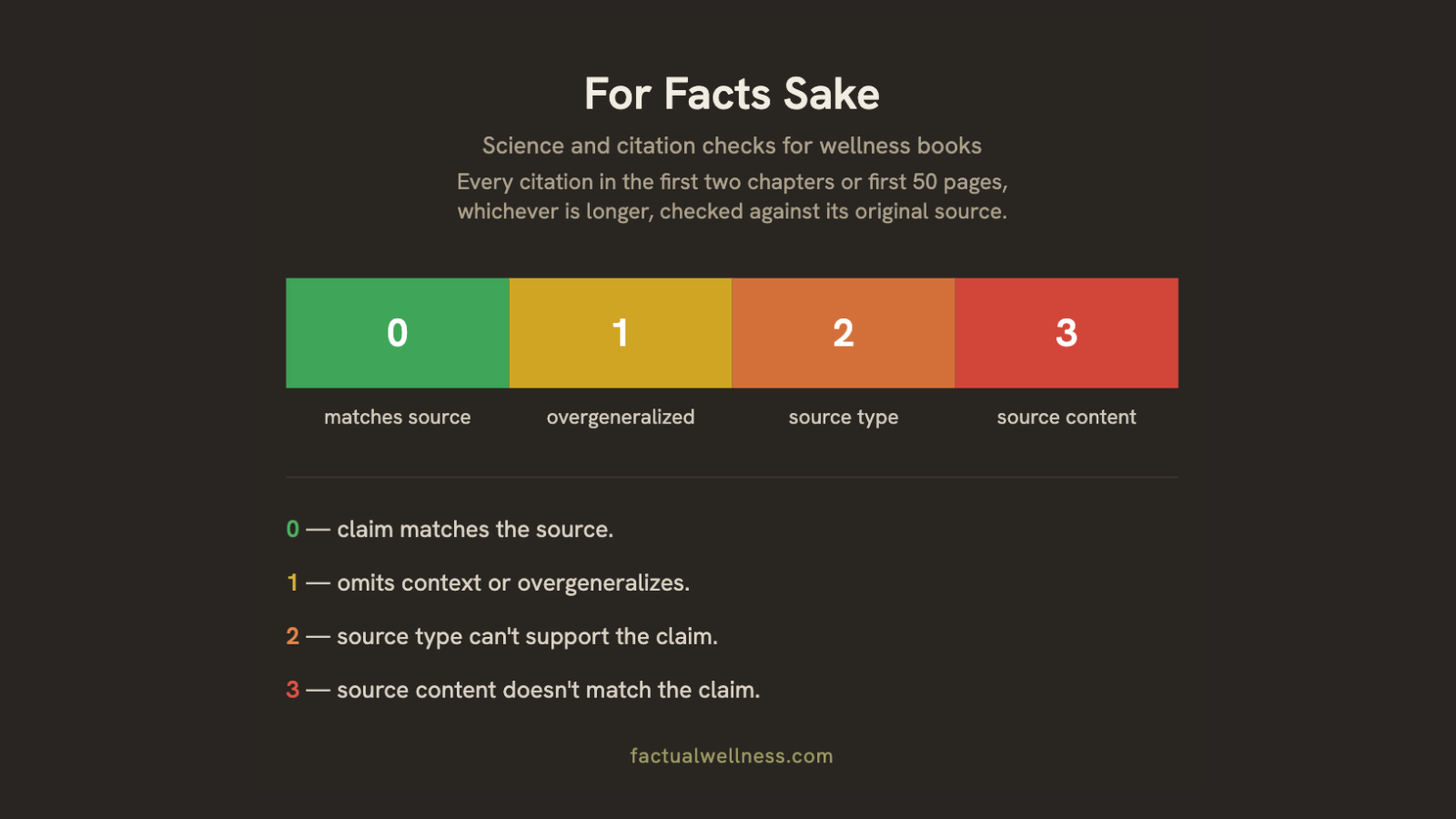
For Facts Sake is a running audit of wellness books that shape how people understand their health. All of the books in the series have three things in common:
- They're popular wellness books that have been on at least one Amazon (or other) bestselling list.
- They provide advice about how readers should eat and manage lifestyles.
- They're written by authors with credentials and invoke both author expertise and the authority of 'science' and 'research' to persuade readers.
Important Notes on the Review Process
"Credentials" come in all shapes and forms. Sometimes they're accredited, regulated, or verified. Other times, they're self-reported or vague and generic (nutritionist is not a regulated term, and anyone can be a "coach"). Often training in one area is used to assert expertise in other areas. For example, an MD who practiced as a gynecologist writes a book on nutritional management of autoimmunity. This is not training-specific expertise, yet this is often the kind of expertise that wellness authors have.
Wellness books are rarely if ever fact-checked by independent scholars and they're not peer-reviewed. Both publisher and author are often covered by disclaimers inside the book. The evidence can be presented to readers in very prescriptive ways, but only the reader carries the risk.
"Science" says lots of things, but even if the author includes citations, readers often don't follow them. The purpose of this project is to do the citation checking for readers and to provide a systematic way to determine how accurately a book describes the source they use.
The Factual Wellness Fidelity Score scale has been created and tested for this purpose, to assess citations in wellness books and to provide an overall score for each book so that readers can have an unbiased (no conflicts of interest to the publisher, the author, or the remedy) and expert review (written by someone actually trained in nutrition science, holding a PhD, and with 20 years of editorial and fact-checking experience).
These scores say nothing about the publisher or author motives; no intent can or will be assessed by this score. No people are being reviewed here, only the actual words on the page.
Consumer health and wellness writing frequently borrows the authority of "research" and "science" without abiding by limits, hedges, or boundaries. Readers who make decisions about their bodies deserve to know where that gap sits.
Here's how the review process works:
- A popular wellness book is purchased by the researcher.
- The first 50 pages or first two complete chapters are read, whichever is longer.
- If there are not at least 50 citations across this span, citation checking extends until a full 50 citations have been checked.
- Citations are checked in order, not randomly sampled throughout the book. This is because an author's argument flows from page 1, and how they set the stage for the problem they propose to address matters. Randomly sampling citations could falsely inflate or deflate a book's fidelity score.
Every book that is reviewed will be published as a standalone post on Factual Wellness.
This is a time-intensive process, but one that benefits consumer interests. Publishers protect themselves and their authors with disclaimers; Factual Wellness has no loyalty to anything other than the readers.
What does a book's fidelity score mean?
The fidelity score measures how faithfully an author translates the sources they cite.
- A fidelity score can tell you how the book translates what a given source actually says and whether the source type can support the claim it's attached to.
- It cannot tell you whether the underlying science is sound, whether the protocol works, or whether the book is trustworthy overall.
- It can show how a book uses the appearance of science to lend legitimacy to its program.
- It cannot show how many claims the book contains that should have been cited but weren't.
- These are not whole-book fact checks.