492 Bestselling Wellness Books: Who writes them, how much they make, & what this tells you


Have you ever picked up a health or wellness book at a bookstore or your library? Have you ever heard one discussed on a talk show, podcast, or social media? There’s a lot of buzz about these books and many of them do sell very well — some of them for decades.
Many people think that popularity means accuracy especially when it comes to books that were written by people with credentials. If you see an “MD” or a “PhD” after someone’s name, especially if you don’t possess that training yourself, are you likely to believe they know what they’re talking about? Probably. Unless you question every credential and take a conspiratorial view to all education, chances are, you tend to place more trust in people who've received training or completed degrees.
But when it comes to books, credentials are more beneficial for marketing than accuracy. Readers tend to think that books are fact-checked or at least reviewed for accuracy before they’re sent into the world. But they rarely are.
Editors make sure books sound good, not necessarily verify that they’re true. In most cases, editors are trained in English and literature, not biochemistry, disease mechanisms, or nutrition science. Fact-checking from field experts isn’t standard practice from the biggest publishing houses, independent presses, and definitely not from self-publishing. If an author wants their work fact-checked, they often have to pay for it themselves. And at least sometimes, an author's translation of the evidence and their belief about their own protocol will win over 'facts' or scientific evidence.
Popularity: What's in a (bestselling) name?
Popularity is its own sort of self-perpetuating cycle. Something sells well, publishers and authors produce more of it. And so on. But taking a close look at what’s selling well right now can give some insights into publishing, marketing, and how everyday reader perceptions might be influenced not by actual evidence, but by the image of evidence.
I surveyed Amazon and gathered 492 top-selling books between May 10 and June 2, 2026. I let Amazon’s algorithm guide me and then filled in the gaps by seeing what appeared on their best-seller lists. Because this search could have gone on forever, I stopped adding books to my spreadsheet on May 30. I then verified sales information and included only those that had appeared anywhere in a top 100 at some point between May 10 and June 2 (when I finished re-checking all the books on the list).
The final book tally was 492 books written by 383 different authors. This isn't every best-selling wellness book on Amazon. Specifically, I excluded books where authors didn't have credentials and didn't claim to be experts (for example, books written by journalists about wellness topics, or books written by celebrities). By "credential" I meant that they had an earned degree (PhD, MD, RD, nursing, psychiatry, LMHC, etc.) relating to wellness and/or they received training or certification that they claim qualifies them to dispense dietary and nutrition information. This does not mean that they're universally recognized as qualified, only that they claim to be experts in some way.
Books were not included if they were textbooks, A-to-Z style reference books, or did not focus on food/nutrition/diet as the primary method of health improvement. Some of them include medications, lifestyle, fitness, etc. but they all also include food/diet/nutrition in multiple chapters.
The Publishing Industry
Within publishing, the lion's share is controlled by five major houses, known as the Big Five. There are also smaller publishers and academic presses, as well as various ways to self-publish. To keep the analysis simple, I split books between these three categories: Big Five, smaller press, or self-published.
Of the 492 books in this study,
- 323 were from Big Five publishers
- 104 came from smaller presses
- 65 were self-published
Making Money
Big Five publishers want to make money, so they mostly give advances to books they’re sure will sell well and make them money. Obviously smaller presses and self-publishers want to make money too, but the prestige of being published by a Big Five house is usually linked with the type of royalty advance an author gets.
In publishing, many deals are reported on Publisher’s Lunch, a subscription-only membership that lists book deals, often including the author, the book’s short premise, the editor who bought the book, and the agent(s) who sold the book. Sometimes deal amounts are also included. Publisher’s Lunch reports these like so:
- "Nice deal": Up to $49,000
- "Very nice deal": Between $50,000 and $99,000
- "Good deal": Between $100,000 and $250,000
- "Significant deal": Between $251,000 and $499,000
- "Major deal": $500,000 or more
Below is a Publisher's Marketplace announcement, using a non-wellness book just for an example.
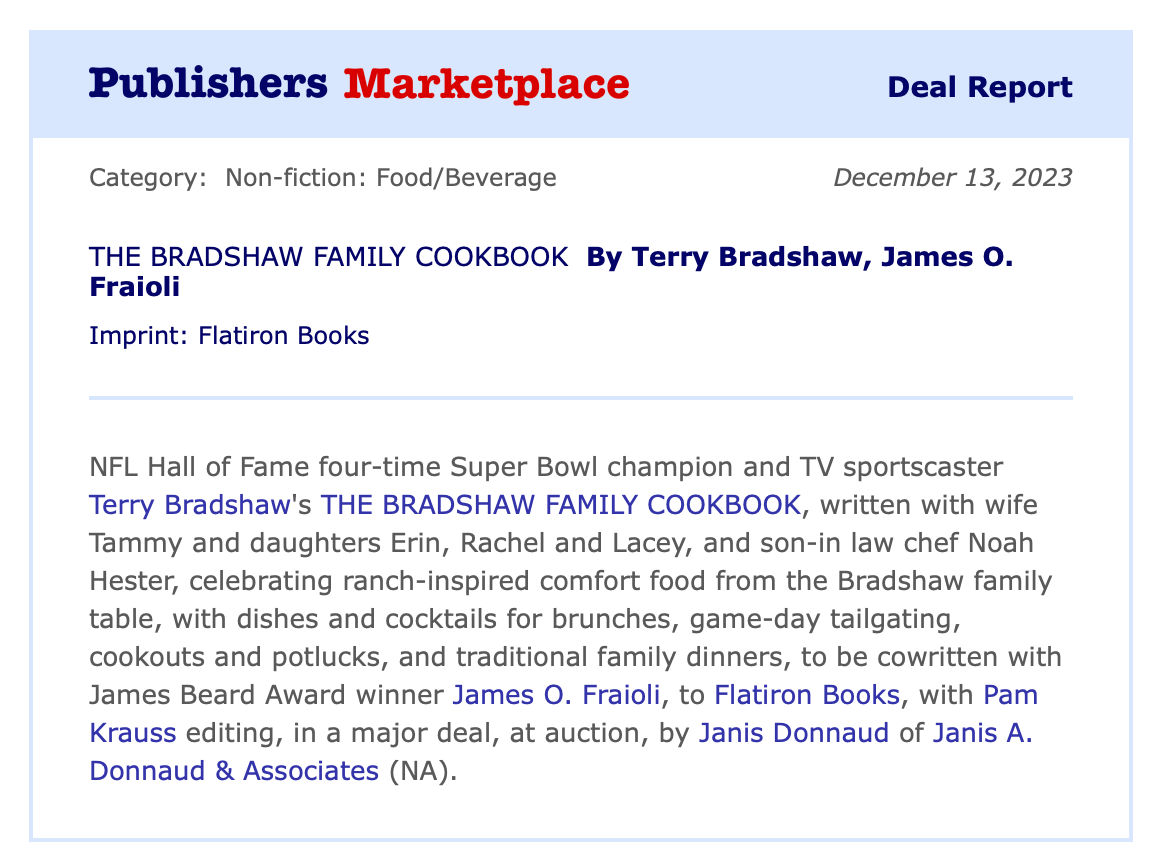
Sometimes book deals use slightly different language, like “very good” or “seven-figure.” Overall, though, we can get a rough idea of how much money is being flung at book ideas and authors when these deals are posted. In the example image above, Terry Bradshaw got at least $500k for his cookbook, and since it was "at auction," it was likely much more than that.
For the 492 books in this study, 190 had reported Publisher’s Lunch deals. Of those, 132 didn’t report any specific dollar amount. The remaining books that did report deal amounts include:
- 7 five-figure deals
- 30 six-figure deals up to $499k
- 16 six-figure deals over $500k
- 5 seven-figure deals
Yes, that’s right. Five of those deals meant the author got at least $1 million dollars for a book deal. Which means the publishers believed they would make substantially more than that. They aren’t doing authors favors. They’re favoring authors who will make them more money.
Most of these big-dollar wellness book deals (51) came from Big Five houses. But 7 smaller presses were competitive in this wellness space. The small press deals included 3 five-figures, 1 up to $499k, and 3 over $500k. Interestingly, all three small-press $500k offers went to the same author, an MD. The 7 small press deals only went to medical providers (six MDs and one dentist).
Expertise
All of the books in this study were written by people with credentials. But as described above, “credentials” doesn’t mean expert; they can be anything from earned academic or medical degrees to someone claiming to be “a nutritionist.” To be eligible for this study, each book had to have at least one author with a claim to be a credentialed expert who received training.
As a sidebar: Most of the authors in this study did not write books about their explicit subject-matter-area training. This will be discussed in a different write-up, but it's important to consider that an MD in one thing (or PhD or master's degree or...) does not make them an expert in all the health things. Most authors bank on the transferability of credentials when it comes to books, even though most of the time these wouldn't hold up in real-life practice scenarios. Someone who has a non-obstetrics degree can write a book about fertility and child-birthing, but they're not going to be let in to a hospital to practice as an OBGYN.
Credentials for Marketing
In this study, 323 books were published by the Big Five. Those book deals went to:
- 194 MDs
- 49 PhDs
- 27 “nutritionists” or “coaches” without regulation or accreditation (not RDs or CNS)
- 22 registered dietitians
- 15 naturopathic doctors
- 13 chiropractors
- And a thinner spread among other credentials, like lawyer, MBA, dentist, pharmacist, therapist, etc.
Clearly, Big Five prefers MDs. But so did the smaller presses, who gave book deals to:
- 69 MDs
- 25 PhDs
- 12 with unregulated certifications/titles (e.g. "nutritionist," "coach," not RD or CNS)
- 11 registered dietitians
- 5 naturopathic doctors
- 3 chiropractors
- And again, a thinner spread among other credentials
Self-published best-selling titles had a similar spread. Of the 65 self-published books, they came from:
- 23 MDs
- 10 with unregulated certifications/titles ("nutristionist" or "coach", but not RD or CNS)
- 8 registered dietitians
- 7 naturopathic doctors
- 3 PhDs
- 3 chiropractors
- And again, a smaller set of other credentials ranging from nursing to physical therapy to counselors, lawyers, MBAs, dentists, etc.
What's the Book About?
Of the 492 best-selling books in this study, 10% (47) of them were weight loss diet books. The next most popular category (38 books) was longevity, followed by brain health (26 books, including topics like Alzheimer’s, general neurology, multiple sclerosis, and Parkinson’s disease).
In a three-way tie for fourth place, there were 25 books each for:
- Fertility, which included periods, PCOS, and endometriosis (but not menopause)
- Immune systems, which included inflammation, allergies, and autoimmunity
- Anti-establishment, which took expose-style or “truth-telling” views of health, wellness, food, and the medical world
The final two most popular represented categories were maintaining/reclaiming health (22 books) and addressing diabetes and metabolic wellness (21 books).
None of this is very surprising since what seems to scare most humans is, roughly, in order: being fat, getting old, losing cognitive function, not being able to birth “good” babies, having a miserable life from autoimmunity, or dealing with diabetes (which often overlaps with weight, longevity, and fertility categories). The fact that the “truth-teller” anti-establishment category ranks so high is not surprising either, given this age of algorithms and "my way or the highway" thinking. The specific views in these books vary wildly and several of them argue directly against each other.
Who Gets the Microphone?
This study had 492 books, but they were written by 383 authors. Some books had author teams, while others were written by a single author. Most authors (72% or 277) only wrote one book represented in this study; 60 (16%) wrote two books, and 26 (7%) wrote three books. Only 2% (7) had written four books.
Some authors can only be described as prolific and popular. Obviously this study doesn't look at every book an author has written, only those that are top-selling right now. And in this study, 5 authors wrote 5 books each, 4 authors wrote 6 books, 1 author had 7 books, 2 authors had 8 books, and 1 author had 9 books. Yes, a single author has 9 currently top-selling books.
What Does Popularity Look Like?
Overall, in this sample of current top-selling books, the authors were 86% white and 53% female.
Ethnicity presentation was, for the purpose of this study, only counted as “presents white” or “presents BIPOC.” This is a potentially fraught area and does not reflect my personal views on ethnicity, race, sex, or gender presentation. Since most readers make snap judgments about books based solely on the book cover, book jacket, and maybe the author’s Amazon page, ethnicity and gender determinations were based on these factors only, not on my personal opinion. Where Amazon author page info was missing, a simple Google search of the author's name was used.
Show Me the Money
Obviously only a subset of the 492 books had Publisher's Lunch deal info. Just 52 of the authors had deal info with an attached dollar range. Of those:
- 24 were white and female (of these, 1 received a 7-figure deal, and 5 deals were $500k+)
- 18 were white and male (of these, 2 received 7-figure deals, and 2 deals were over $500k+)
- 6 were BIPOC and male (of these, 1 received a 7-figure deal, and 2 deals were $500k+)
- 4 were BIPOC and female (of these, all 4 were 6-figure deals of $499k or less)
It has been widely known that the publishing industry is still majority-white. Women of color are still the most likely to have their expertise undervalued compared to men and white women in traditional publishing deals.
Genres
So what kind of books does the publishing industry reward with these massive money deals? From the books with reported Publisher’s Lunch deals that had money ranges attached, the seven-figure book deals were:
- Weight loss (3)
- Longevity (2)
The 13 books that got deals over $500k were:
- Weight loss (3)
- Mental health & stress (2)
- Longevity & anti-aging (2)
- Autoimmunity (2)
- Alzheimer's (1)
- ADHD-focused (1)
- Chronic pain (1)
- Gut health (1)
Summary
- Credentials are useful marketing tools but tell the reader nothing about expertise or qualifications to dispense advice on this subject in this particular way.
- Publishers invest most in the books that play off the biggest human fears (aging, body weight, fertility, etc.) because that sells, not because there are actual answers.
- Despite the U.S. being fairly diverse, most of the top-selling books are written by white people. Systemically, we have to consider that who gets centered or controls the conversation also shows who gets sidelined. None of us can see from a body we don't live in. White people may not try to think in a majority-rules fashion, but still do not understand what it means to live in Black or Brown bodies. Similarly, able-bodied people may want to be accepting of disability, but they do not know what it means to live in a disabled body and to be seen as disabled. Men may want to be allies for women, but still haven't lived in the body of a woman.
- Most of the books are also written by MDs. MDs are highly trained in their specialties, but that does not make them highly-qualified to dispense nutrition advice. Some of them may also hold nutrition training or certification, but what these books have in common is certainty and a one-size-fits-most plan they can sell you in 300-some pages. And because people are different, these plans will work for some, but not all, and the ones they don't work for (through effort that doesn't pay off or through not being able to afford it in the first place) will be the ones that take the blame. The plan itself, the book, the protocol, will remain insulated from failure. That's not proof of a program that works; that's a stopped clock being right twice a day. The diet gets the credit when good things happen; the reader gets the blame when they don't.
- Before you think that bestselling = best info, consider that publishing is a money-making-first industry and that what sells best isn't necessarily the best information.
For Facts Sake: Scientific analysis of wellness books that help you decide what claims to trust.