Peptide BPC-157: Hype or help?


Peptides are getting a lot of buzz these days. But what actual evidence is there? I'm a nutrition science PhD. Let's review the research.
PubMed and Peptide BPC-157
If you go to PubMed and search "BPC-157," you'll get a decent 209 results.

Now this is where most journalists, article-writers, influencers, and even supplement companies will stop. "BPC-157 is a peptide with over 200 clinical studies!" That's just hype, of course.
Next Step: Filter for "Humans"
I don't care about how many studies there are. I care about how we can apply this to humans based on actual evidence. You're not a mouse, a moth, or a test tube. You're a human and it's meaningless to take data from anything else and apply it to you.
When I filter for humans in PubMed, things simmer down a bit. Now we're left with only 47 results.

Forty-seven isn't nothing, but even journalists, influencers, or supplement marketers who are savvy will stop here. "Our Peptide BPC-157 is backed by over 45 human studies! Some companies make exaggerated claims about cell studies, but at Supplement Company 101, we value actual human data. You can trust our product because we know science." Again, more hype, wrapped up in manipulative language that makes them seem better because they'll point out the failings of other less-good companies.
But as a researcher, I know that just filtering for "humans" doesn't mean these are all human clinical trials. No, the filters on PubMed are a bit wonky and sometimes researchers will inflate how results are presented. If the study is done from human cells, it gets labeled humans. But that doesn't tell us anything about how a substance behaves in human bodies. You're a complete machine, not a single celled-human.
Last Step: Filter for Trials
Okay, what I want to know is how many human clinical trials, randomized controlled trials, or even just observational studies have been done. How many actual humans have taken this peptide and been observed, measured, watched, or followed by researchers? That's the real question.
Answer: Apparently, zero?
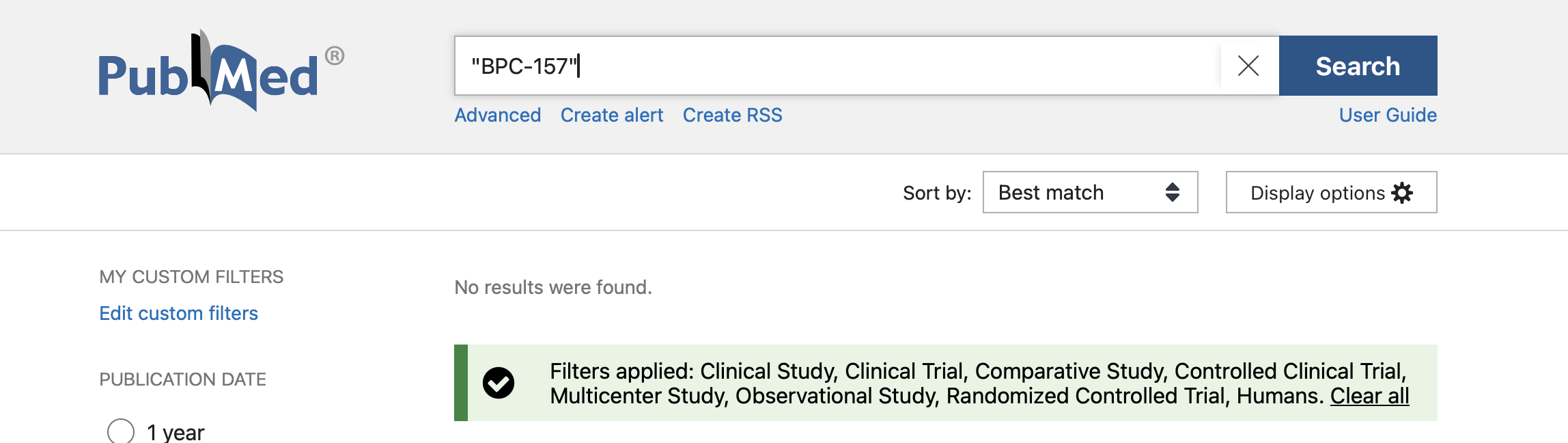
What!? No human clinical trials at all? How is this peptide getting so much buzz?
This isn't shocking at all, actually. This is how most of the supplement and wellness world actually works. They often don't put human safety or actual scientific data first. They are selling a product that needs to be profitable. Marketers who get tapped for this job almost never have scientific backgrounds or maybe even any degrees at all, beyond how to effectively manipulate (I mean, market).
A Sidebar About Supplement Marketing
I am not against all who work in marketing. Persuasion isn't always the same as manipulating. However, I take issue when products that are marketed for human ingestion with health claims are not absolutely, accurately, and ethically promoted. The little FDA disclaimer that they slap on their products in the tiniest print possible does nothing except protect them from liability.
So, yes, I have very little faith or trust in supplement marketing practices. And in the case of BPC-157, that skepticism is absolutely warranted.
What Research Says About BPC-157
Despite the fact that there don't appear to be many human trials of BPC-157, if you still want to know what the research says, here's a brief round-up. I assessed all 47 of the PubMed results that were labeled 'human.'
Many of the results are reviews, which do not represent original human studies or research. There were also some editorials. So while both types are still legitimate "scholarly" articles, they are not human intervention studies and can't state anything new or unique about the effects of anything in human bodies. These get quoted a lot by marketers, though.
In the words of one article:
- "The majority of studies have been performed on small rodent models and the efficacy of BPC 157 is yet to be confirmed in humans." (From a review, not a trial.)
There are also many studies that are irrelevant to BPC-157 supplements because they are:
- Injections for knee pain (and more injections for interstitial cystitis, which is what many actual human studies have used for research)
- Taken from human tissue and studied in test tubes
- Intravenous infusion (in 2 participants only) to test for safety (but "safety" after 3 days, or an otherwise short-term use from IV infusion, is not the same as "safe when taken orally for months or years")
- Rat studies (and more rat studies)
- Spinal cord injury recovery... oops, but still in rats
- About finding ways to test for BPC-157 in urine for anti-doping purposes (not for benefits, just for presence)
- About treatment of colitis... rats, also in rats
- After acute and chronic alcohol exposure... drat, but this time in mice
- For protective effects of gastric cells... alas only in rats and mice
- In rats and also humans... wait, human cells in vitro (but marketers could easily take this and say "Human research found BPC-157 to have therapeutic benefits.")
Nutrition PhD Conclusion About BPC-157 Supplements
This article did not review every study ever published about BPC-157. Sometimes results are not on PubMed. I did not do an exhaustive search of every database because I have enough info to confidently say:
- No, this supplement has not been proven effective in humans for the various things it's being marketed for.
- Oral BPC-157 supplements have little, if no, evidence. I am certain that studies using injections, IV infusion, and/or animal data are being used to convince consumers to buy BPC-157 oral supplements. These are not transferrable results.